This is it. The end of my life as I’ve known it so far.
The number 144,000 flashes on my wristband and illuminates the bare, steel walls of the switch cell. When the number’s glow fades, everything turns black again.
In.
Out.
My breathing rumbles through my ears, and the silence envelops me like a thick blanket.
Just seconds ago, four armed members of the Guard filled my cell, their feet shuffling, pens scratching notes. Hands plucked at me while tight faces watched. Without a word, they examined and disinfected every inch of my body, shaved my head, and tied a thin leather strap around my wrist. I changed into a standard pale-gray jogging suit. They took everything I had, then vanished behind the thick wall that slid shut behind me.
I’m sure all four of them are still standing there now, their weapons at the ready, eager to punish a reckless escape attempt.
I have nowhere to go.
In.
Out.
The switch cell is barely five feet by five. I stretch my arms out, and my fingers graze the walls of my temporary prison. I know it’s a false sense of protection, but I let myself believe that at this moment, I am alone—and alone, I am safe.
In.
Out.
In.
Out.
I look up, and thanks to the blinking light of my wristband, I see a ventilation grid in the ceiling about seven feet above. It’s the only thing that interrupts the cell’s otherwise smooth, gray surfaces. I focus on the walls and consider whether I could scale them, but I know that even if I could, the grate is too narrow for me to squeeze through.
I adjust my breathing to the rhythm of my wristband’s flashing, trying to regain control of my emotions like my dad taught me. I count the seconds—three beats to breathe in, five to breathe out—but it doesn’t calm me down.
I’ll only be in this switch cell for five minutes—I know that. But for some reason, it feels like an eternity. Five minutes is enough time for the Guard to set my wristband, lock me up, and wheel my cell into the Hangar. Five minutes is also enough time for every horrific story about what awaits me to claw through my mind. I have seen battered youths leave this prison in just their underwear—and those were the ones who made it out alive.
I need to calm down. I can’t let them see my fear when the door opens.
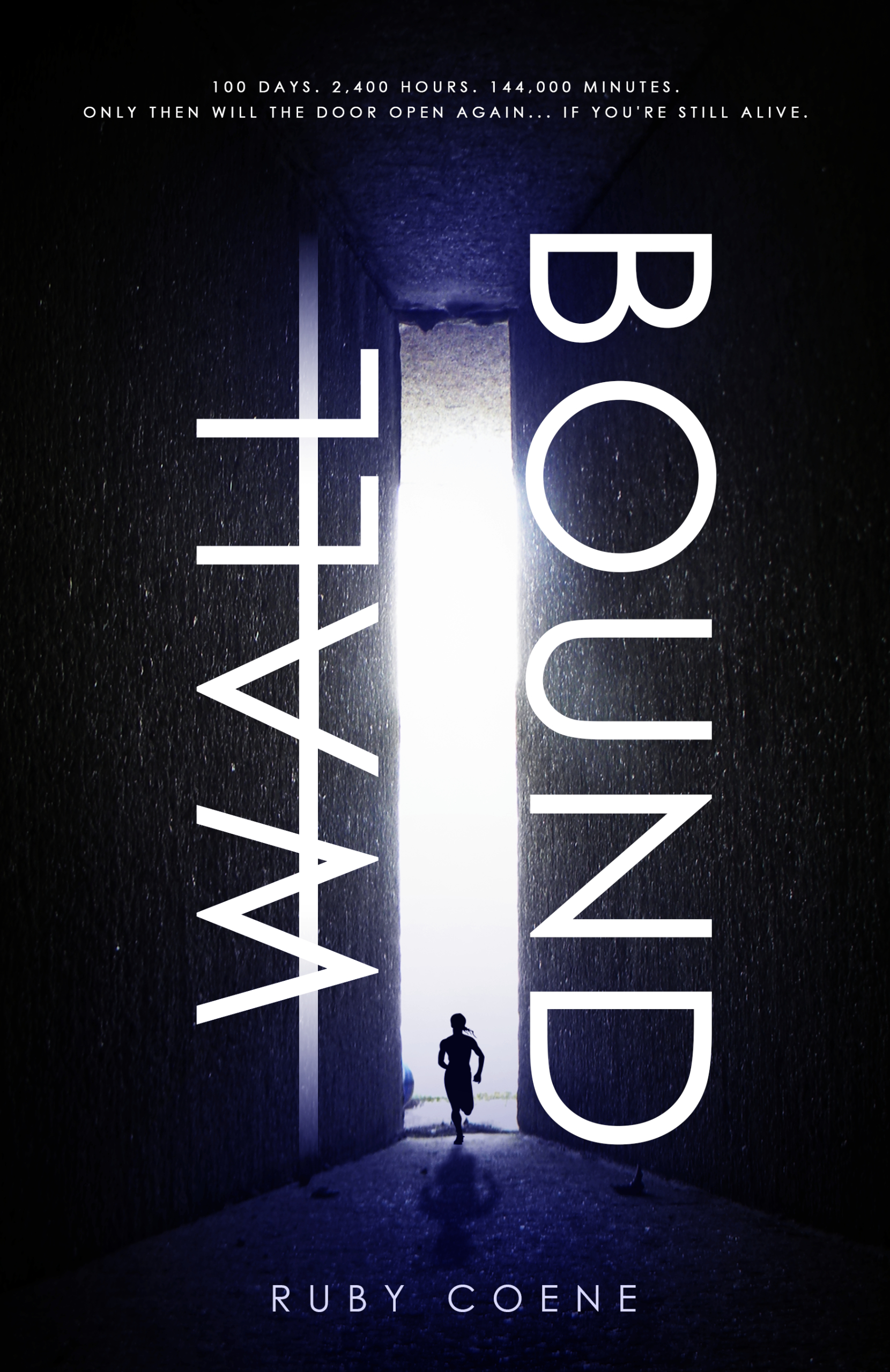
144,000 minutes.
2,400 hours.
100 days.
The standard punishment for a minor offense.
With a trembling thud, the cell begins to roll down the tracks that lead into the Hangar. The crunching sound of iron on iron sends goosebumps up my arms. These are the final steps of my penance, right before my real punishment begins.
Just as abruptly as the cell started moving, it comes to a halt. Another sound replaces the grinding—a louder one that grates my chest, not my ears. Stone scrapes over stone as the Hangar’s concrete wall opens to receive my cell.
I’ve seen enough educational videos about the Hangar to know what’s happening just by listening. At least once a year in high school, we’d see footage of a cell creeping down the tracks of the switch corridor, thick cables pulling it toward the Hangar.
Once again, my cell moves with a jolt. I can barely hold myself up straight. Adrenaline courses through my veins.
Behind me, the scraping of stone against stone resounds again, and I know my five minutes are almost up. I bite my lip hard enough that a scab pops open. The wound bleeds, but the pain is all that keeps me from throwing my body against the steel walls, sobbing and screaming for forgiveness, begging them to let me out of here.
The Hangar’s wall slides back into place with a dull thud. Despite my efforts to calm down, my heart beats in my throat. My only way out is hermetically sealed.
My wristband stops flashing, the numbers coming to a stop. I hold my breath as a vibration pulses through my arm. From now on, my numbers will count down, and with each drop, I’ll be one minute closer to freedom.
I hear a loud click and, agonizingly slowly, the door opens for me. My heart beats louder, stronger, and I feel like I can’t breathe. I must remain calm. I must not show weakness. I force myself to suppress my fear—as much as possible, at least. I focus instead on the emotions I know much better.
Anger.
Rage.
Aggression.
A sudden beam of light widens, shining into the switch cell. I blink and hold my hands up, shielding myself from the blinding brightness.
“Five.”
My panting breath hisses through my ears.
“Four.”
A computer voice slowly counts down the seconds I have left.
“Three.”
Quickly, I step out of the cell.
“Two.”
The cold from the floor seeps through my socks and into my feet.
“One.”
You have reached the end of this free sample.

 Publisher